

Selling on Amazon can be valuable to many business owners, whether you’re a small business launching its first product line or an established company seeking global expansion.
As the world’s largest online marketplace—with more than 200 million Prime members and hundreds of millions of active customer accounts—Amazon has extraordinary brand recognition, and its onboarding process for businesses is relatively easy. Still, you might have some questions before creating your Seller central account, which gives you access to a suite of tools and resources to manage your business.
This guide offers tips and strategies for building a successful business on Amazon.
How to sell on Amazon for beginners
- Conduct market research
- Choose a selling strategy
- Write a business plan
- Create an Amazon seller account
- Decide which fulfillment option to use
- List your first product
1. Conduct market research
Use market research and competitive analysis to help you decide what to sell on Amazon. You’re looking for products that are trending and have a good profit margin in a space with relatively weak competition. There are a few ways you can assess the current market landscape on Amazon and decide which products to prioritize:
Review Amazon bestsellers lists
Amazon’s bestsellers page is a great place to find product ideas based on what’s selling well right now on the site. Although it takes time for a product to attain Amazon bestsellers rank (it’s based on sales volume), you can still get a sense of what consumers are buying. Can you offer a version of a popular product that serves a specific niche or satisfies an unmet need?

Use keyword research tools
Jungle Scout is a popular keyword research tool that can narrow down your list of ideal products to sell. When you use a keyword research tool like this, you make decisions based on data. The search volume of a product helps you determine consumer interest.

Read Amazon reviews
When customers review products, they may unwittingly reveal gaps in the market. Take a look at Amazon product reviews to determine what customers like and dislike about specific brands and products. You may be able to find a consistent problem with competitors’ products that your product can solve.
Check for restrictions
After deciding which products you are going to sell, check Amazon’s list of product restrictions to make sure you are in compliance. Items like fine art, surveillance equipment, and recycled electronics are among the products not allowed. Certain products must go through a preapproval process before you can sell them. Read the overview of product categories before setting up your account.
2. Choose a selling strategy
Depending on the product you’re selling and the amount of capital at your disposal, you’ll likely choose one or more of the following ways to sell on Amazon:
- Retail arbitrage. If you buy something below market value and sell it at a higher price while profiting off the difference, that’s retail arbitrage. Amazon sellers can search for products on sale or clearance at places like Target, Best Buy, and Big Lots, then sell them on Amazon for a higher price.
- White labeling. Generic products with your own brand name or logo added are known as white label products. You don’t need to have any manufacturing or product design experience to sell white label products—your focus is primarily on sourcing quality products and creating appealing branding.
- Private labeling. Private-label products are produced by a third-party manufacturer based on retailers’ specifications. Retailers then market and sell those products under their own brand. You can find private label products through marketplaces like Alibaba and Thomasnet.
- Dropshipping. When dropshipping on Amazon, you never keep products in inventory. When someone purchases a product, the order goes to a third party. The third party then fulfills and ships the product to the customer.
3. Write a business plan
Draft a strategic business plan that details elements that are crucial to business success. Action items can include the following:
- Listing your products to sell
- Determining product pricing
- Defining your marketing plan
- Identifying your ecommerce business model
- Creating a plan for inventory management
4. Create an Amazon seller account
To create an Amazon seller account, you must first decide what type of seller plan you need: individual or professional. The main difference between the two depends on your projected volume of sales.
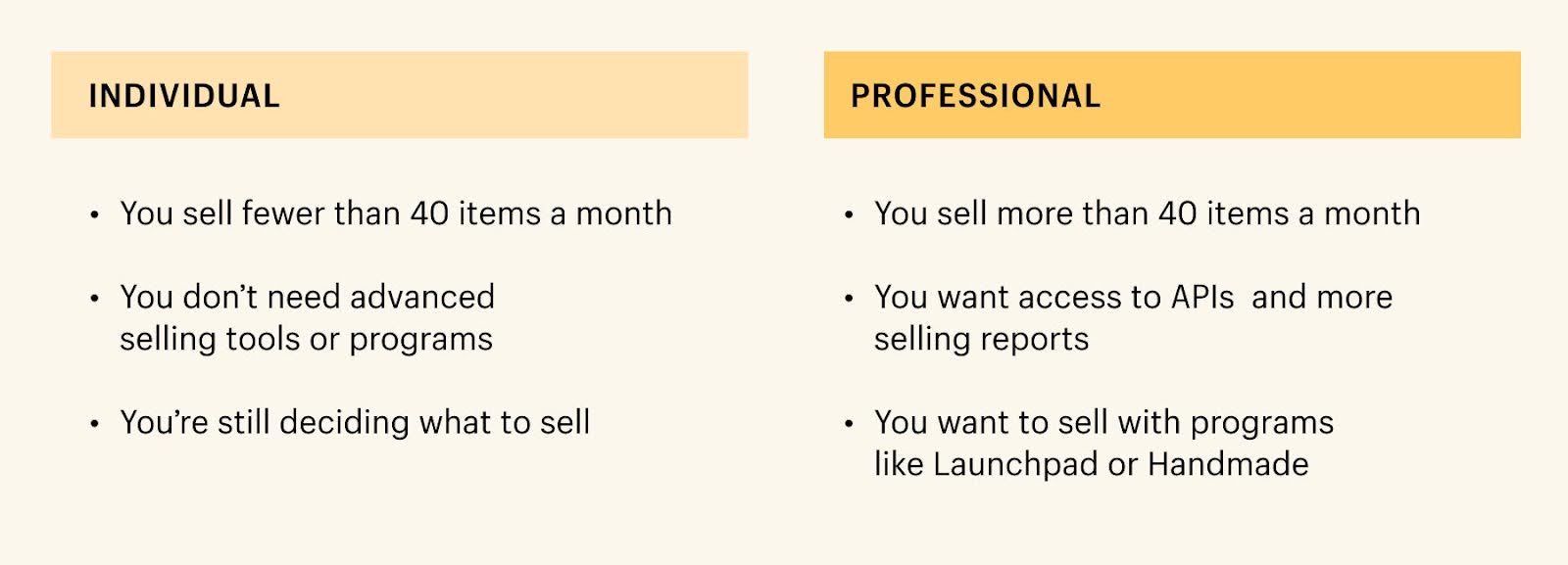
The individual plan is a pay-as-you-go plan that gives you access to basic listing and order management tools. Individual sellers pay a 99¢ seller’s fee every time they sell an item. If you sell fewer than 40 products per month, the individual plan may be for you. Once you sell more than 40 items per month, the individual plan becomes more expensive than the professional plan, so you may as well upgrade.
The professional seller plan is a $39.99 monthly subscription service that offers a suite of tools and benefits, including global selling programs, advanced business reports, and eligibility for Amazon’s Featured Offer position.
Once you’ve selected a plan, it’s time to set up your new Amazon seller account. Collect the following information and enter it on the Seller Central signup page:
- Business email address
- Bank account number and bank routing number
- Active credit card
- Government issued national ID
- Tax information
- Phone number

Once your Amazon seller account is approved, you’re ready to get your products listed and start selling.
Read more: Is selling on Amazon worth it for you?
5. Decide which fulfillment option to use
As a seller, you have two fulfillment options: fulfillment by merchant and fulfillment by Amazon:
Fulfillment by merchant (FBM)
With FBM, you fulfill orders directly to customers and manage shipping, returns, and customer service. This is a good option for made-to-order products or for products that require a longer lead time for processing.
Fulfillment by Amazon (FBA)
With FBA, you send inventory to an Amazon warehouse, known as an Amazon Fulfillment Center (FC). These fulfillment centers ship products and manage returns from customers. You control inventory levels and pay storage fees for the product, in addition to a fulfillment fee for every unit sold to customers. Keep in mind, you still own the inventory until a customer receives it.
In this model, Amazon handles payment from the customer and, in turn, pays you. You get access to Amazon’s customer service team that handles questions, returns, and refunds.
6. List your first product
There are two ways you can list a product on Amazon: The first is for products already for sale on Amazon—these products have an existing Amazon Standard Identification Number (ASIN), and your listing will be combined with the product detail page for all other sellers offering this product. The second is for new products (private label products) that you’re listing on Amazon for the first time.
Let’s consider the initial example: Say you’re selling travel mugs you bought at wholesale prices, and there’s already a listing on Amazon for that exact product.
1. The first thing you’ll need to do is copy the ASIN from the "product details" section of the existing listing.
2. Next, navigate to Seller Central, click Catalog and select Add Products. This brings up a search bar where you can paste the ASIN. Doing so will bring up the product listing. Use the dropdown to describe the condition of your item (New, Used - Like New, Used - Very Good, etc.)
3. Click “Sell this product,” set your price, select your fulfillment options (FBM or FBA), and follow the subsequent prompts. You have the option to enter a SKU for your item, after which you can click the “Save and finish” button. You can view your listing in the “Manage inventory” page of your Seller Central account.
Now let’s look at the process for listing a product that has never been sold on Amazon, like your own line of emu leather platform clogs. Here’s how it works:
1. From the Seller Central dashboard, you’ll again click “Add a product” followed by “I’'m adding a product not sold on Amazon.”
2. Choose your product category from the list, then enter all relevant information about your product (title, price, details, photos, fulfillment options).
3. Once you’re done with this, simply click “Save and finish” and your product will be submitted for approval. Once it’s approved, Amazon will assign it an ASIN and list it for sale. You can access the listing via your “Manage inventory” page.
Once your product detail page is live, shoppers can discover your product by searching on Amazon. If your product has appeal and you use effective marketing strategies, soon enough the orders will start rolling in.
How to create successful product listings on Amazon
- Write a targeted product title
- Upload clear product images
- Write thorough product descriptions
- Include product variations
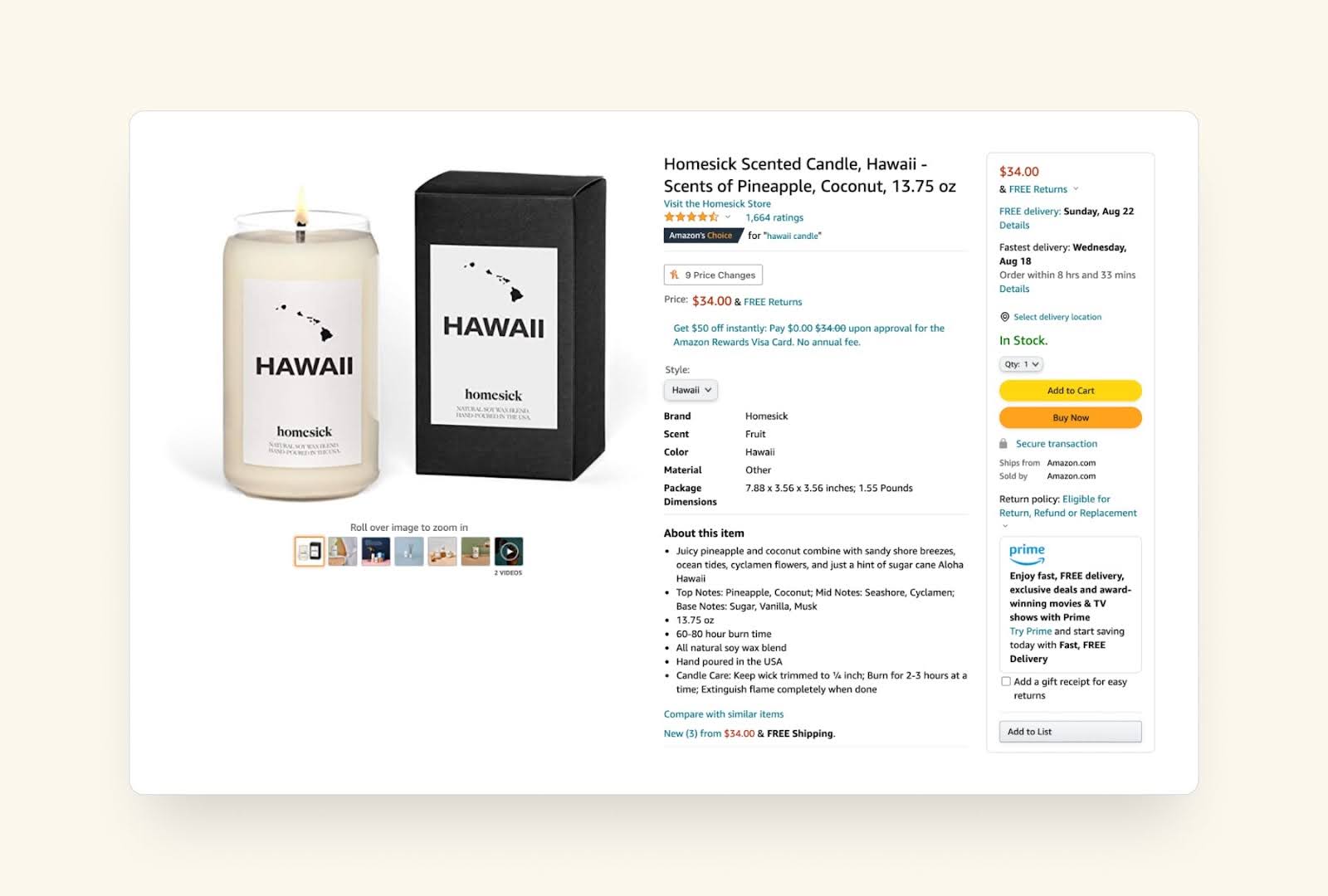
The product detail page of your product listing is where the sales happen on Amazon. The information you put on this page helps customers decide whether or not your product meets their needs. Candle brand Homesick has a stellar example of a product page. Let’s look at why.
1. Write a targeted product title
Your product title should capture shoppers’ attention and tell them they are in the right place, and a good one can improve your click-through rate in search and improve your SEO ranking within Amazon’s platform.
Product titles have a 200-character limit, but you’ll want to keep your title between 60 and 80 characters. Why? An Extensiv study of more than 3,000 high-ranking Amazon listing titles found 33% of them fell between 60 and 80 characters, and the Amazon Seller Central guidelines recommend keeping titles in this range.
Every word in your product title is searchable, so aim to include vital information. For example, Homesick uses its brand name (Homesick), the product line (Scented Candle), the style (Hawaii), features (Scents of Pineapple, Coconut), and the container size.

2. Upload clear product images
Your main photo should clearly show what the product is. Additional photos can provide other angles of the product and, if relevant, lifestyle imagery.

You can also add video to give shoppers a more in-depth look at your products. Shoppers can scroll through your media to assess if the product is a good fit for their needs. Take care that your images are high quality so that shoppers can zoom in to see the finer details of your product.
How many images should you include? According to the Extensiv study, the top 62% of Amazon listings had between five and eight images.
3. Write thorough product descriptions
Product descriptions list the specifications and benefits of your product. Homesick uses bullet points for its descriptions, highlighting key information potential buyers look for in a candle, such as burn time, scent notes, and type of wax.

4. Include product variations
Variations let you easily display the same product in various sizes, colors, and styles. While each version of a product has its own unique ASIN and detail page, variations give customers the ability to quickly switch between options.
Cost of selling on Amazon
When you start selling on Amazon, there are some fees you should be aware of because they’re frequently charged and can impact your Amazon channel’s return on investment (ROI). The following fees aren’t the only fees, just the common ones:
- Referral fees. Amazon charges a commission for selling on the platform. It’s different for each category. The average referral fee is 15% but can range from 8% to 45%.
- Closing fees. This is a $1.80 fee taken from each unit sold for products in media categories (books, DVDs, music, software and computer/video games, video game consoles, and video game accessories).
- FBA fees. If you use Fulfillment by Amazon you’ll pay a fee that covers picking, packing, shipping, and customer service. The exact cost depends on your product’s category, size, and weight, but it starts out at just a few dollars.
- Additional Amazon fees. Amazon will also charge you storage fees for inventory in its fulfillment centers, with additional fees for aged inventory that has been in storage for more than 181 days. You may also have to pay fees for unsold inventory that Amazon returns to you, discards, or liquidates.
For an in-depth look at all possible fees, read the selling on Amazon fees guide.
Tips for selling your products on Amazon
- Encourage product reviews
- Run sponsored product ads
- Take advantage of promotions
- Drive external traffic
- Get your pricing right
Amazon gives ecommerce businesses a unique opportunity to sell products to a wider audience, helping improve brand awareness in the process. Here are key tips for getting there:
Encourage product reviews
Reviews can be the deciding factor in a purchase, even if the product has a higher price than competitors’ offerings. One way to encourage reviews is to send a follow-up email after a customer purchases your product.
Amazon sellers can send customers automated follow-up emails that are related to a specific order. The guidelines are here but, in summary, you may not:
- Send emails with marketing or promotional messages
- Include links to websites other than Amazon
- Request or incentivize positive reviews
You can, however, send emails that ask the customer to leave a review—so long as you don’t specifically request that the feedback be positive.
There are ample best practices for email marketing out there, but aim to send no more than two emails: one during the order confirmation or delivery phase and one post-purchase email after the customer receives the product.
Run sponsored product ads
Amazon has a robust ad platform that lets you market your products to Amazon customers. Amazon Sponsored Product Ads is a PPC (pay per click) model that lets you promote your Amazon products. Ad placements on desktop can be above, alongside, or below search results for related search terms, as well as on product detail pages.
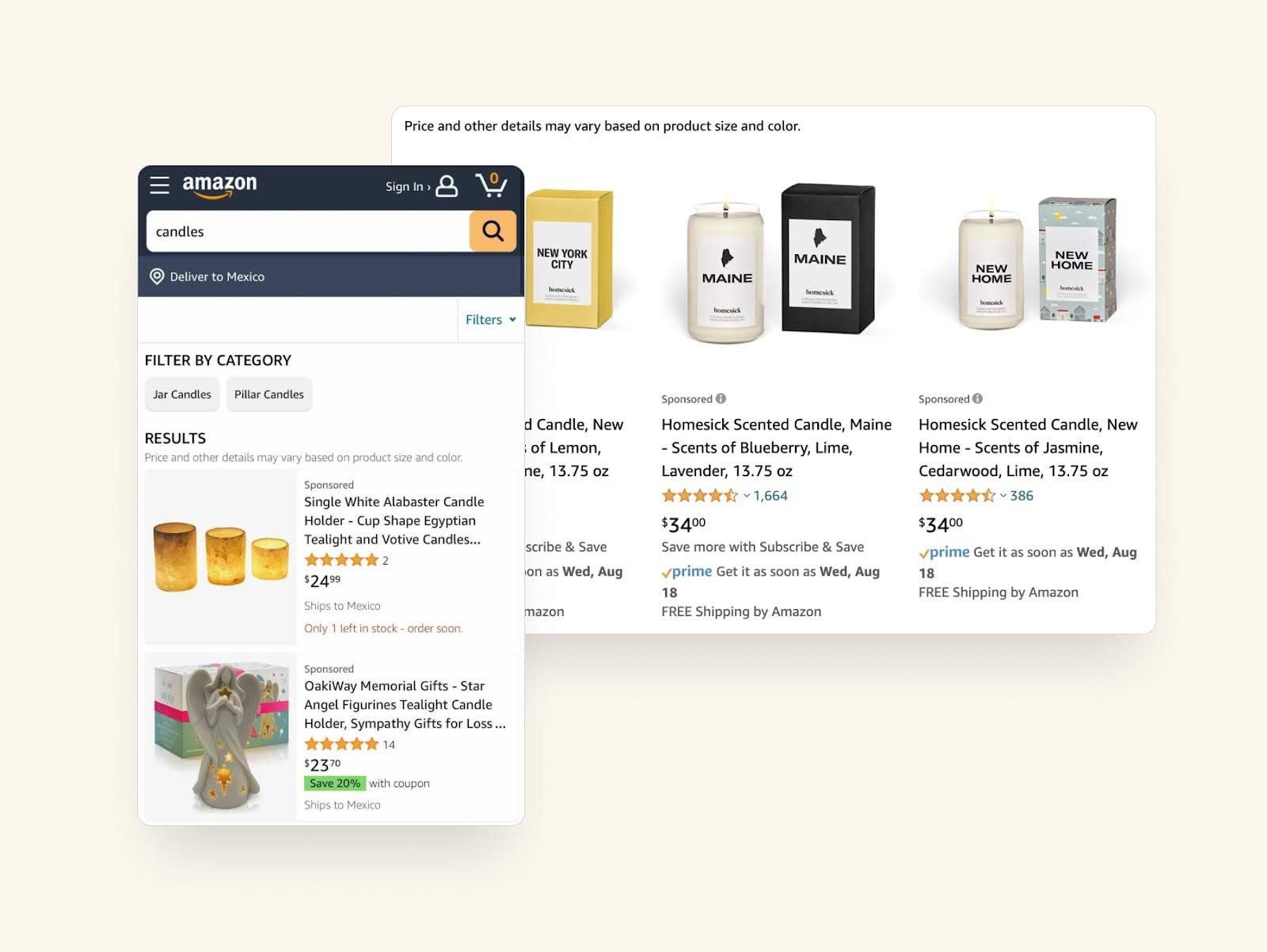
A few things to keep in mind when running Amazon PPC ads:
- Start with automatic targeting. This allows Amazon to use its powerful search algorithms to automatically discover and suggest an exhaustive list of potential keywords for you. You can begin by selecting a flat default bid across all keywords, but your eventual goal is to get data on how various keywords perform and target the ones that are most effective.
- Evaluate your automatic targeting campaign. Assess your automatic targeting campaign once you have at least a few weeks’ worth of data to determine which keywords performed the best. You want to transition those over to a manual campaign, where you can focus on only the most relevant keywords. With a manual campaign, you have the ability to adjust bids by keyword.
- Continue to iterate your manual campaign for keywords and bids. Different bid amounts can yield various placements and results, so continue to test until you find a strategy that works well for you.
- Use insights to optimize product details pages. As you refine your PPC strategy, you’ll gain a better sense of which keywords are relevant to your product. You can add those keywords to your product detail pages to help you capture more organic traffic without having to pay for ads.
Take advantage of promotions
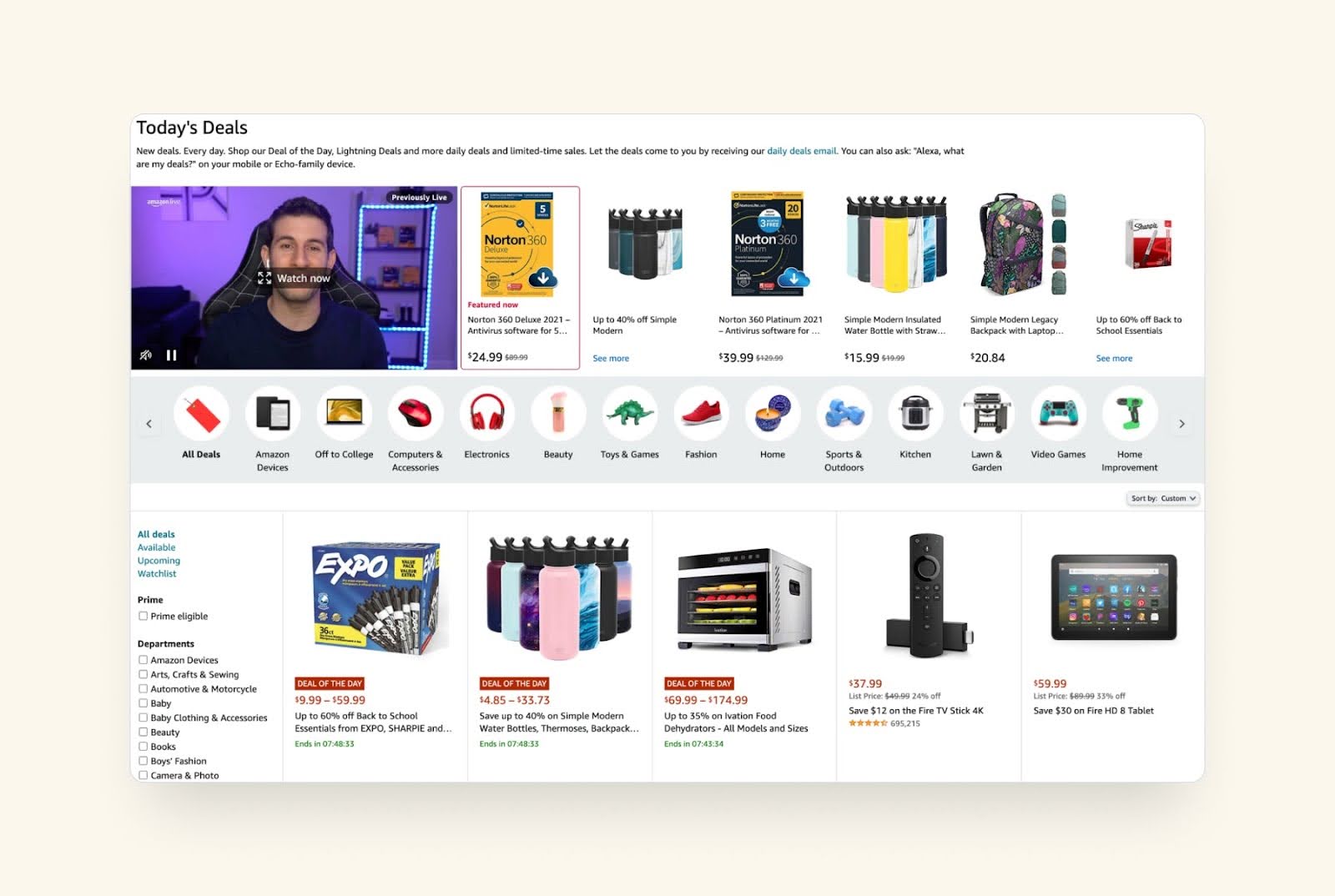
Leveraging promotions can help you generate sales and increase brand awareness. A popular type of promotion on the Amazon platform is Lightning Deals. These deals are flash sales featured on the Amazon Deals, one of the most frequently visited pages on Amazon.
Lightning Deals can help:
- Increase discoverability of your product, especially during big events such as Prime Day and holidays.
- Lead to more online reviews due to greater product reach and sales.
- Drive conversions after the promotion ends, as more units sold can improve rankings on search engine results pages.
- Trial new products and win new customers for future purchases.
Lightning Deals appear in the “See All Recommendations” section of the screen on Seller Central. Lightning Deals run across many different categories, including health and personal care, home and kitchen, consumer electronics, fashion, grocery, and much more.
Drive external traffic
Many brands reserve their external marketing channels to point to their ecommerce store. While there is value in using ads to direct traffic to your own site, those same tactics also work to promote your Amazon listings.
If you collaborate with bloggers and influencers, you can expand your reach through programs like Amazon Associates and Amazon Influencers—as well as external platforms for connecting with influencers, such as Shopify Collabs.
Additionally, you can create discount codes to share externally, such as on your social media channels, to encourage customers to buy on Amazon.
Get your pricing right
Finding the right pricing strategy for your products is especially important in Amazon’s marketplace, where you compete against other sellers. Here are some key considerations when aiming to hit the right pricing:
Amazon Marketplace Fair Pricing Policy
According to the Amazon Marketplace Fair Pricing Policy: You can’t set a price “that harms customer trust.” Amazon offers some examples of pricing practices that raise red flags, including pricing a product significantly higher than recent prices offered on or off Amazon, selling bundles of multiple units for a higher price per unit than if sold individually, and adding excessive shipping fees. Avoid a potential account suspension by pricing your products fairly.
Automate pricing
Repricing tools like Amazon’s Automate Pricing on Seller Central help you to automatically make pricing decisions. With the free Automate Pricing tool, you can establish parameters for pricing products and specify how to automatically adjust product prices to a competitive level.

Complement your Shopify store by selling on Amazon
At first glance, Amazon can seem like a challenger to your ecommerce business: a global marketplace, a massive audience, a go-to destination for consumer search. However, when approached as a resource, Amazon can actually help entrepreneurs make money online. Under the right circumstances, selling on Amazon is worth it for Shopify store owners.
Your Shopify store is your home base, and Amazon’s global marketplace is your opportunity to reach massive new audiences. Strategic planning, experimentation, and some hustle will get you a long way to successfully selling on Amazon.
Read more
- The Ultimate Guide To Dropshipping (2023)
- The Beginner's Guide to Selling on eBay- List, Manage, and Sell Your Products Through Shopify
- AliExpress Dropshipping- How to Dropship From AliExpress
- The 13 Best Dropshipping Suppliers in 2023
- How to Start a Dropshipping Business- A Complete Playbook for 2023
- How To Source Products To Sell Online
- The 9 Best Dropshipping Websites for Your Online Store
- How to Start an Online Boutique- A Complete Playbook
- How to Write a Perfect Business Plan in 9 Steps
- How to Set Up & Open a Pop-Up Shop
Selling on Amazon FAQ
Is it free to sell something on Amazon?
Amazon charges a referral fee for each item sold. The rate changes depending on the product category, ranging from 8% to 45%.
What is the startup cost to sell on Amazon?
Setting up an Amazon Seller account is free if you sign up for the Individual plan. You will only pay as you sell products. If you sign up for a Professional Seller account, you’ll pay $39.99 per month.
Can I sell on Amazon from my home?
Yes, like many ecommerce sellers, you can create a home-based, online business selling on Amazon.
What are some good products to sell on Amazon?
- Toys and games
- Electronics
- Video games
- Books
- Clothing and shoes
- Jewelry