


Business-to-business (B2B) ecommerce is having a resurgence. In North America, B2B ecommerce reached $2 trillion in 2023. Worldwide, B2B ecommerce is also surging: In 2022, the worldwide market for B2B ecommerce was over $2 billion and is projected to reach $166 billion by 2032. This growth trajectory suggests an impressive compound annual growth rate (CAGR) of 22.50% over the next decade.
But DTC is also seeing astounding growth.
Direct-to-consumer (DTC) retailers like Allbirds are leading the way by initiating wholesale deals. And in the first quarter of 2023, Solo Brands, the owner of Chubbies, Oru Kayak, and Solo Stove, saw wholesale revenue increase by 52.3% to $33.5 million compared to Q1 2022.
This poses a real question: Why are brands pivoting away from DTC and shifting toward B2B sales? And why do the majority of those B2B sales happen online?
This article shares the key benefits of the B2B ecommerce business model—either as a native DTC brand expanding into B2B for the first time or as a traditional retailer pivoting from in-person B2B sales to online.
1. Increased brand recognition
Brand recognition is a struggle for DTC-only brands. The level of exposure you get largely depends on your customers’ willingness to shout about your products in public. (Or by splashing thousands on DTC marketing—more on that later.)
Selling via B2B channels like wholesale, however, increases brand recognition at scale. Resellers buy your products at wholesale prices and do the promotion for you.
Whether it’s another online store or brick-and-mortar retail location, your product packaging—which includes your logo, brand name, and any trademarked slogans—appear in channels your retail partners manage.
"Wholesale allows us to reach a larger audience and generate more sales. It also opens the door for partnerships and collaboration with other businesses. For example, we have worked with a retail store to create exclusive product bundles. Wholesale increases brand recognition and credibility within the industry," says Luke Lee, CEO of Pala Leather.
Take Olipop as another example. The alternative soda brand previously only sold directly to the end consumer via their ecommerce store. However, the brand added a wholesale arm to their business, most recently selling through over 20,000 retail locations with only 12 flavors.
The same is true even if you’re a legacy B2B retailer who typically sells in-person. Shifting to B2B ecommerce allows you to increase brand recognition by selling to the mass market at scale. Instead of facilitating B2B wholesales through manual processes, an online storefront allows B2B buyers to self-serve.
The more B2B customers you can serve, the more places your products will be visible to the general public.
2. Minimal B2B marketing costs
With DTC, the only way people hear about products is with a huge marketing or advertising budget. That’s a dangerous game to play.
Apple’s iOS 17 release makes it harder for brands to track customer activity and monitor the return on investment of any marketing campaign. Google followed suit with their death of third-party cookies, contributing to increases in the cost per click for paid ads on search engines between the second and third quarters of 2021.
With B2B ecommerce, on the other hand, marketing is done on your behalf. Resellers will make your product appear in the window of retail locations, on the shelves of busy department store shelves, and in digital marketing campaigns. In all cases, your B2B customers do the promotion for you, rather than using your own brand’s marketing dollars.
The process of marketing to B2B buyers is also vastly different from DTC marketing. Business buyers best engage with a personalized account-based marketing approach. Selling on a one-to-one basis to other businesses is cheaper than marketing to the masses through free-for-all social media channels.
Customer highlight: Since upgrading to Shopify Plus, al.ive body hit a record-breaking sales milestone, generating over AU$1 million during Black Friday in just four days. By customizing their checkout experience, they also boosted customer conversion by 47% during sales seasons. Read al.ive body’s story
3. Lower customer acquisition costs
No marketing dollars makes it cheaper and more profitable to acquire B2B customers.
We can see this demonstrated with a bathworks Shopify merchant who walked into a retail store and pitched them to carry the brand’s products. Time was the only required resource for cold-pitching—a tactic that helps the business secure large orders on a small scale. It’s a B2B sales strategy not easily replicable at scale for DTC-only brands.
Shaunak Amin, co-founder and CEO of SwagMagic, adds, “While B2C typically increases individual sales, B2B provides opportunities to generate revenue at scale. However, just as it is with B2C, B2B clients will order from a specific vertical so many times. This makes it vital to cross-sell to your niche audience by catering to their various business needs.
“And you can do this by adopting a multibrand strategy to expand your offerings to include related products and services, enabling you to acquire customers at different entry points.”
“It’s the same customer, different sales strategy, in which you become a one-stop shop,” Shaunak says. “This makes it difficult for other companies to compete against you. While at the same time, it keeps customer acquisition costs low as their lifetime value grows. It’s an excellent way for ecommerce businesses to innovate in their respective niches.”
4. Higher order value and volume
The biggest difference between B2B and DTC customers is the volume and frequency in which they purchase.
Business buyers don’t buy in single units. In Po Campo’s case, founder Maria Boustead says, “Our B2B site makes it easier to buy a larger volume of products at once. On the B2C site, most people just buy one or two things. On the B2B, retailers order 15 to 25 items at once.”
B2B buyers purchase more frequently too, especially if you streamline the ordering process and make it easy for buyers to self-serve through your B2B ecommerce website. It’s not uncommon for buyers to reorder large quantities on a regular basis—be that once a day, week, or month.
You can’t say the same for consumers in verticals like fashion and apparel. It’s extremely rare that end consumers have enough disposable income to buy products from the same brand every week or month.
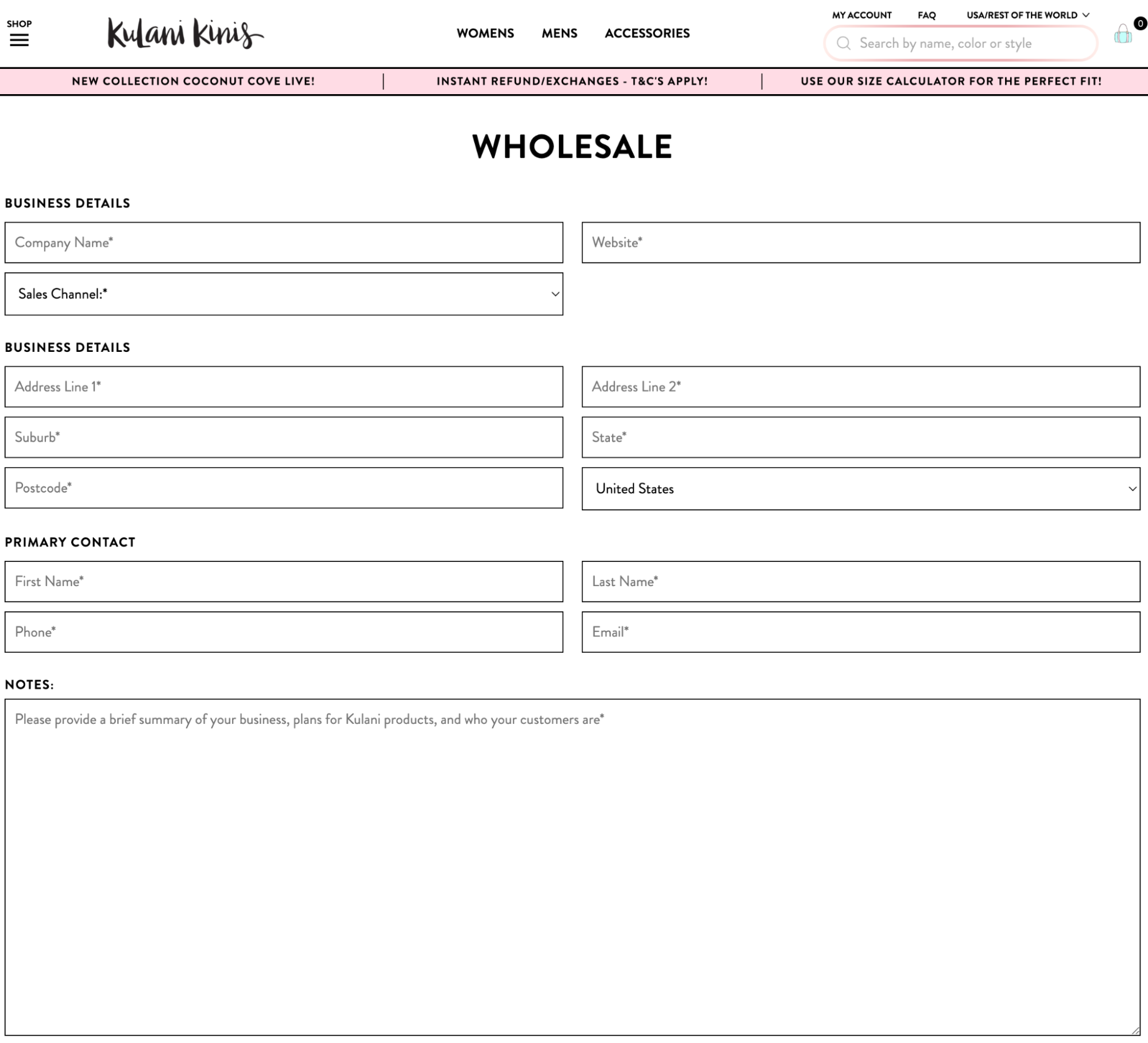
Customer highlight: Kulani Kinis started using Shopify Plus’s B2B feature to create a user-friendly, customized DTC store just for wholesale customers. The company saw 3X growth in customer base and a 60% YoY increase in wholesale revenue, expanding their brand internationally. Read the Kulani Kinis story
5. Default loyalty creates predictable revenue
When you have a B2B business, most people buy from you by establishing long-term relationships. You don’t have to keep them coming back—there’s a mutual understanding that if the product is good, the relationship could last years.
This default loyalty creates predictable revenue for your business. Unlike DTC businesses, which can be massively impacted by external factors such as a recession or seasonal trends, most businesses place regular orders to supply their own customers. You’ll have greater certainty over your cash flow and more accurate planning abilities to scale.
Brian Lim, founder and CEO of INTO THE AM, says, “Due to the nature of the products they sell, B2B businesses often have a smaller pool of potential customers than B2C businesses. However, these customers are usually repeat buyers, since they tend to purchase the same or similar products on a regular basis. For an ecommerce business selling B2B, this repeat business can be a major source of revenue.”
“B2B businesses typically have longer-term relationships with their customers,” Brian adds. “This gives them a better understanding of the customer’s needs, which can help to foster trust and loyalty over time.”
6. Automated sales and business processes
There are a lot of moving parts when managing B2B sales offline. A traditional B2B company online would need a sales representative to build the relationship, input the order in your system (sometimes using pen and paper), raise invoices, and remind customers when their payment is due.
But the biggest benefits to moving B2B business online are:
Reduced human error: Use workflows to automate the entire B2B sales process and reduce human error. There’s less risk of shipping the wrong products, incorrectly billing your customers, or forgetting to remind them of an upcoming payment.
Greater flexibility to improve sales and AOV: Scale your B2B sales strategy with DTC-style sales features like upselling and product recommendations. In both occasions, you can squeeze more money out of existing customers—without forcing your sales team to convince them individually.
Faster order fulfillment: Take orders from wholesalers through an online sales portal at any time of the day, and create streamlined packing slips for your warehouse teams to fulfill. Shipments get out the door—and with your customer—faster. It’s those DTC-like customer experiences that encourage repeat orders.
Better decision-making: Merge merchandising, sales, and logistics data with ERP integrations to get the full picture and make better business decisions. If you manage B2B and B2C orders through one single separate inventory management system, for example, it’ll be easier to forecast demand across both channels, avoiding dead or surplus stock.
Customer highlight: Momofuku is no stranger to hitting sales of $500,000 in a day. Using Shopify Scripts and Shopify Flow, the brand automates sales launches and has built a solid foundation to conduct B2B sales. Read Momofuku’s success story
7. Offload international distribution
An online presence sets your business up to go global. Launch in new markets from a single DTC front end. But in reality, the logistical headache that comes with international expansion is expensive and time-consuming.
Expand into B2B and let new customers do the distribution for you. If you’re a US-based CPG brand, for example, expand into new markets by selling wholesale to European B2B customers. You simply ship inventory to one international location; resellers act as distributors of your product.
It’s a strategy used by activewear brand Vuori, whose international expansion strategy relied heavily on the distribution of its retail partners. B2B customers helped Vuori’s products appear in seven new international markets.
Even fan-favorite DTC brand Glossier announced layoffs amidst their pivot to wholesale. CEO Kyle Leahy said, “Now, we’ve grown, the marketplace has evolved, and our consumers are looking for us to meet them where they are: in-store, online, at retail partners, and around the world.”
8. Reduced operational costs
A natural byproduct of B2B orders is lower operational costs. One single order of more than 100 units needs fewer labels and shipping boxes, and therefore, lower operational costs than if you were selling individually to the end customer.
Plus, B2B buyers want self-service options when buying online—another cost saving advantage of selling at scale through a customer-centric ecommerce site. There’s no need to fork out thousands on attending trade shows, manually creating orders, or sending invoice reminders.
A self-serve B2B ecommerce platform allows buyers to purchase without drawing precious resources like time. That leaves your B2B sales team more time for building relationships. They can discuss new products, share marketing advice, and give buyers insight on upcoming trends that ultimately help your products sell in their store.
And, with one ecommerce back end that delivers standalone B2B and DTC storefronts, there’s no need to fork out for two individual commerce platforms to differentiate the front-end shopping experience for either customer.
Shopify Plus makes it much cheaper and easier to merge the two than having isolated sales channels for each customer persona. It’s a single ecommerce back end designed to help businesses:
See real-time inventory levels across both B2B and DTC sales channels.
Display contextual pricing and payment terms (such as net-30) depending on whether a customer is a B2B brand or end consumer.
Set minimum and maximum order quantities to keep wholesale orders profitable.
Operate a password-protected ecommerce portal for B2B buyers to store their information, such as saved credit card details, previous orders, or invoices.
The best part? There’s no need to use third-party apps to operate and run wholesale channels alongside your DTC storefront. Give B2B buyers the highly personalized, modern, and seamless buying experiences they want to lend from DTC—without the operational burden of two back ends.
Take it from JuneShine, an online drinks retailer that walked away from DTC purely because of its low profit margins. In an interview with ThingTesting, cofounder of Forrest Dein said, “Even when you just look at above the line—cost of goods, shipping, fulfillment and packaging—it was lower margin than wholesale.”
"Every dollar we put into wholesale is building a long-term revenue stream that's much higher margin. You can't say the same for direct-to-consumer," adds Forrest.
If any industry understands the need for personalization, it’s DTC. And it’s something B2B is paying close attention to. In fact, Gartner revealed that 71% of B2C customers expect personalization, while 86% of B2B customers expect it during service interactions with companies.
But there are limitations to how deep DTC can go with tailoring buyer journeys.
B2B ecommerce tends to have more complex personalization capabilities than DTC, allowing it to deliver a more enhanced customer experience. For example, B2B companies often offer unique prices and contract agreements to cater to the unique needs of their business customers. DTC offers one-size-fits-all prices, but makes up for this with discounts.
This level of customization is necessary for B2B, where sales cycles are long and complex, and deals contain bulk orders or other sizeable needs (e.g., enterprise-level data plans).
To achieve this, B2B brands must use data-driven insights that extend beyond customer behaviors and purchase history (as in DTC). It must know individuals within a company, what deals they’re associated with, the companies they represent, and the unique requirements of that company and industry.
More advanced B2B ecommerce companies are tailoring every touchpoint to each buyer persona, including email, search ads, social media, AI chat, and website landing pages. This works because, in B2B, sales cycles can last for months, which means buyers may engage with the brand multiple times on various channels before committing.
DTC, on the other hand, relies on broader intel, such as pages visited, gender, age, birthday, and past purchases, to serve personalized ads, landing pages, and emails. Then there are challenges unique to DTC that inhibit its personalization efforts, such as:
Rising customer acquisition costs that can limit resources for personalization efforts
Selling face-to-face to strangers without history makes it impossible to personalize the customer experience
Competing with giants like Amazon, which have the technology to offer deeper personalization, which makes retention and loyalty a problem
The deeper your data, the easier it is to sell your product or service and retain customers long-term. So far, B2B is winning in this arena.
10. Higher customer retention via ongoing support
When a customer purchases a product or service from a DTC company, they don’t receive ongoing hands-on engagement from the brand. Sure, there’s a telephone, forum, or email the customer can use when they run into issues. But most of the time, all a DTC customer will receive is a series of post-purchase emails offering tips for using the product or service.
In B2B, companies are more thorough—customers receive a dedicated account manager who follows up via email or phone to onboard them and offer ongoing support. This further enhances the personalized experience because the account manager knows the customer’s business needs and can offer better advice and answers.
Some even offer self-serve support tailored to the customer’s use case. For instance, the B2B company may build a knowledge base for each industry and use case, featuring videos, walk-throughs, blog posts, and forums.
Offering various venues and a customer success manager boosts customer satisfaction and increases the odds of customer retention. B2B companies that send customer surveys multiple times yearly see an 82% retention rate. Compare this to the 28% average retention rate for DTC businesses.
If you plan to offer a dedicated account manager, advertise it to ease the customer’s worry for improved sales engagement.
11. Easier to scale your business operations
Long-term relationships. Bulk high-value orders. Low marketing costs. International distribution. Throw in automation and you have the perfect recipe for scaling an operation. And as we’ve mentioned above, B2B ecommerce excels at all of this.
Unfortunately, DTC isn’t built for large volume orders, customization, or flexibility like a B2B ecommerce business. So it lacks the ability to scale to the heights a B2B company can. A lot of the tasks in B2B ecommerce are automated, allowing more to get done with fewer resources, further improving profit margins.
Thanks to B2B ecommerce platforms like Shopify Plus, brands can manage large order volumes, shipments, and complex logistics. The advanced inventory management and flexible payment solutions provide a great experience for everyone. In other words, you can scale without hurting your operations or customer experience.
To further prove the potential of B2B ecommerce—a report shows the global B2B ecommerce market is set to grow to $36 trillion by 2026. Compare this to the global B2C ecommerce market, which will grow less in more time—$5.5 trillion by 2027.
Customer highlight: Since taking on Shopify Plus, DARCHE has seen an increasing number of its B2B customers flock to the online store to place their orders, attracted to the simplified ordering experience they now offer. The brand is forecasting a 3x YoY increase in B2B sales in FY24. Read more about how DARCHE uses Shopify Markets to expand their international footprint.
Take advantage of ecommerce’s B2B power
The power of B2B ecommerce is immeasurable. Ditch manual processes, scale customer acquisition, and let buyers self-serve on their own terms with a B2B ecommerce solution.
If you’re thinking about expanding into B2B for the first time, know it’s not as complex as you might think. The benefits of B2B ecommerce—higher average order value, reduced cost, and predictable revenue—far outweigh the minimal time investment required to create a B2B platform with Shopify Plus.
Take your B2B business online with Shopify Plus. From order management to purchase data, combine both channels in one ecommerce back end. B2B customers get the online experiences they crave, without impacting DTC sales.
Read more
- 6 Best Open-Source Ecommerce Platforms for 2023
- 11 Ecommerce Checkout Best Practices: Improve the Checkout Experience and Increase Conversions
- Six Must-Have Technologies to Build the Best Ecommerce Tech Stack
- B2B Ecommerce: Everything You Need to Know to Get Started
- Find the perfect domain name
- 12 B2B Ecommerce Trends To Shape Your Business in 2023
- What Is Wholesale B2B and How To Sell To Customers in 2023
- What Are B2B Payments? Methods & Processing Systems
- B2B Marketplaces: What They Are, How to Succeed, and 8 Marketplaces to Consider

