Skip to Content
Shopify
  • By business model
    • B2C for enterprise
    • B2B for enterprise
    • Retail for enterprise
    • Payments for enterprise
    By ways to build
    • Platform overview
    • Shop Pay
    By outcome
    • Growth solutions
    • Shopify
      Platform for entrepreneurs & SMBs
    • Plus
      A commerce solution for growing digital brands
    • Enterprise
      Solutions for the world’s largest brands
  • Customer Stories
    • Everlane
      Shop Pay speeds up checkout and boosts conversions
    • Brooklinen
      Scales their wholesale business
    • ButcherBox
      Goes Headless
    • Arhaus
      Journey from a complex custom build to Shopify
    • Ruggable
      Customizes Headless ecommerce to scale with Shopify
    • Carrier
      Launches ecommerce sites 90% faster at 10% of the cost on Shopify
    • Dollar Shave Club
      Migrates from a homegrown platform and cuts tech spend by 40%
    • Lull
      25% Savings Story
    • Allbirds
      Omnichannel conversion soars
    • Shopify
      Platform for entrepreneurs & SMBs
    • Plus
      A commerce solution for growing digital brands
    • Enterprise
      Solutions for the world’s largest brands
  • Why trust us
    • Leader in the 2024 Forrester Wave™: Commerce Solutions for B2B
    • Leader in the 2024 IDC B2C Commerce MarketScape vendor evaluation
    • A Leader in the 2025 Gartner® Magic Quadrant™ for Digital Commerce
    What we care about
    • Shop Component Guide
    • Shopify TCO Calculator
    • Mastering Global Trade: How Integrated Technology Drives Cross-Border Success
    How we support you
    • Premium Support
    • Help Documentation
    • Professional Services
    • Technology Partners
    • Partner Solutions
    • Shopify
      Platform for entrepreneurs & SMBs
    • Plus
      A commerce solution for growing digital brands
    • Enterprise
      Solutions for the world’s largest brands
  • Latest Innovations
    • Editions - Spring 2026
    Tools & Integrations
    • Integrations
    • Hydrogen
    Support & Resources
    • Shopify Developers
    • Documentation
    • Help Center
    • Changelog
    • Shopify
      Platform for entrepreneurs & SMBs
    • Plus
      A commerce solution for growing digital brands
    • Enterprise
      Solutions for the world’s largest brands
  • Try Shopify
  • Get in touch
  • Get in touch
Shopify
  • Blog
  • Enterprise ecommerce
  • Total cost of ownership (TCO)
  • Migrations
  • B2B Ecommerce
    • Headless commerce
    • Announcements
    • Unified Commerce
    • See All topics
Type something you're looking for
Log in
Get in touch

Powering commerce at scale

Speak with our team on how to bring Shopify into your tech stack

Get in touchTry Shopify
blog|Business Management and Leadership

Ecommerce Funding to Scale and Grow (Without Giving Up Part of Your Business)

If you haven’t had the door slammed in your face … You’ve likely had a nightmare based on a fear most of us have or have had at some point in the entrepreneurial journey: the fear of running out of cash. Banks are turning away people like you and me frequently. They don’t see the gaps we see in our markets. They don’t see the late nights, the hard work, or the sacrifices. The banks often just don’t care. Fortunately, there’s a brand new source of capital designed specifically to help the underdog grow his or her business and beat the competition.

by Shopify
Getting Ecommerce Funding Without Giving Up Part of Your Business: How Shopify Capital Helps Merchants Accelerate Growth

Commerce moves fast. Shopify moves faster.

Try Shopify
  • Since 2016, Shopify Capital has provided $230M to thousands of businesses to purchase equipment, inventory, and launch products 
  • In just a few clicks and a couple of days, you can get the cash you need without giving up equity, pitching, nor impacting your credit score
  • Capital advances have helped Shopify Plus business Brute Force grow YoY sales 100% for four straight years
  • “Shopify Capital is definitely helping us get to $5 million [in ARR] faster,” says Justin Eberle, Director of Operations at Brute Force

Nothing to sell for the holidays and broke …

That’s the nightmare Justin Eberle found himself in when he woke up the day after Black Friday 2015.

“We sold everything we had,” Eberle recalls. “We went through the rest of the holiday with no inventory.”

Eberle runs Brute Force — selling fitness sandbags to police officers, military members, and civilians who want a workout that’ll better help them achieve their everyday goals. Working out with sandbags more closely mimics the unstable loads firefighters, SWAT team members, or grandmothers bending over to pick up a grandchild encounter in the real world.


Ironically, helping others become more physically stable made Brute Force less stable; without money for inventory Eberle would not be able to meet demand and continue growing. It’d also make it much more difficult to repay his father, who mortgaged a home he already owned to help Eberle grow Brute Force.

“I definitely didn’t ever want to feel that panicky feeling again,” Eberle says of running out of inventory.

But seeking traditional sources of funding to buy more inventory would likely prove too time-consuming. Eberle needed a quick cash injection but lacked the time to pitch investors or schedule meetings with banks.

Even if Eberle had time to wait on a bank’s decision … he knew he couldn’t expect the big banks to make getting cash easy.

Out of Luck, Out of Pocket

It’s no secret: capital is essential to grow quickly and maintain high-volume sales.

It’s why Shopify created Shopify Capital, a cash advance product designed to help businesses quickly secure financing and accelerate their business growth. Shopify tailors cash advances to each merchant’s needs based on data processed through the Shopify platform.

Accessing this financing is designed to be as simple as a few clicks:

  • Get cash advance offers of different amounts, at different rates
  • Choose the one right for you and get approval in a few days
  • Pay back the advance by remitting a percentage of daily sales
  • Shopify Capital does not impact your credit score

Since its launch in April 2016, Shopify Capital has issued more than $230 million in merchant cash advances and is being used by thousands of businesses to purchase equipment and inventory, launch new products, hire more employees, and add new sales channels.

“For many businesses, securing capital is a frustrating and time-consuming process,” said Saad Atieque, Product Manager at Shopify.

“With Shopify Capital, we’re giving businesses a simple, fast, and convenient way to secure financing to invest in their business. Similar to our payments and shipping solutions, Shopify Capital represents one more way Shopify can help businesses strengthen their operations.”

Learn more about Shopify Capital

‘Helping us get to $5 million faster’

In 2016, Brute Force used Shopify Capital to double its USA made inventory without cutting any corners operationally. However, the cash advance gave Brute Force something more important than inventory.

“It really gave us the confidence we needed,” Eberle says. “I saw sales skyrocket.”

Since then, Brute Force has used Shopify Capital to maintain what the company calls rolling inventory. Instead of ordering stocky quarterly, Brute Force now forecasts demand and uses its newfound liquidity to order more of its top-selling items every week.
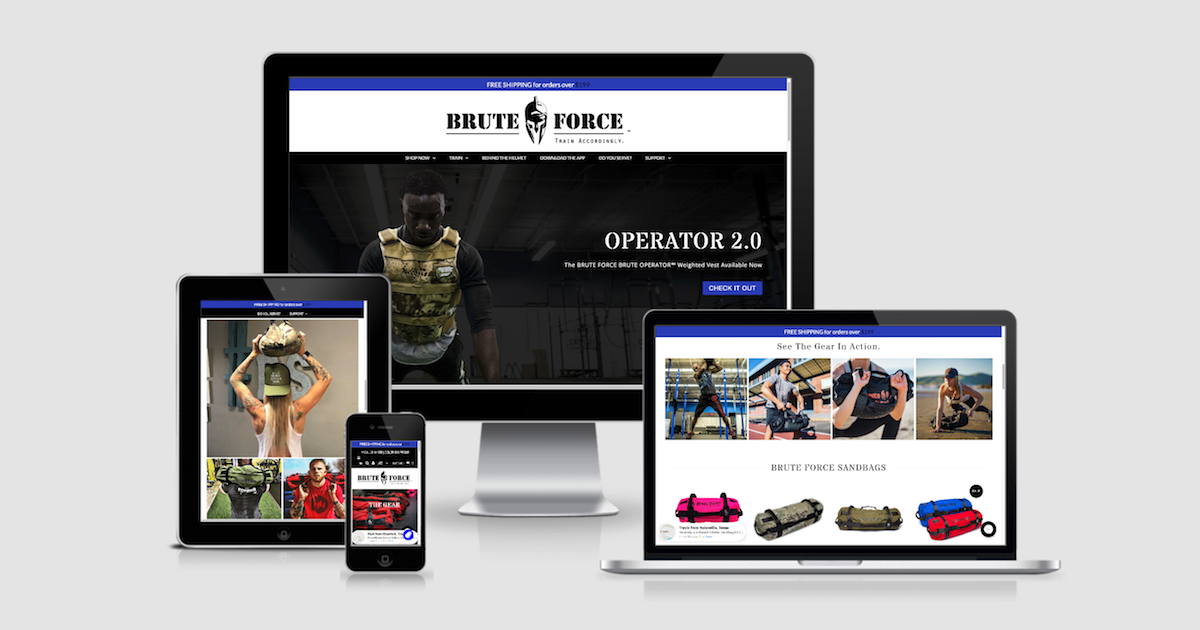
With $20,000 of inventory on hand each week now instead of $8,000, Brute Force can deliver its most popular items faster and offer a much-improved customer service.

In all, Brute Force has taken four Shopify Capital advances totaling nearly a half million dollars to:

  • Grow non-holiday monthly sales to $200,000
  • On pace to generate $5 million in revenue in 2018
  • YoY sales growth of 100% for the fourth straight year

“Shopify Capital is definitely helping us get to $5 million faster,” Eberle says. “Instead of taking time away from the business to meet with investors or banks, you can use Shopify Capital immediately and execute faster.”

With its inventory problems solved, Brute Force is now focused on growing its human capital. Specifically, Eberle plans to build a team of marketing and operations all-stars to rapidly scale Brute Force beyond $5 million.

The company is considering new training centers outside of its headquarters in Denver where it certifies Brute Force training coaches who go back to their hometowns and train others. It’s increasing the number of Brute Force coaches who fly to firehouses, military bases, and police headquarters to train first responders and the like.

It is also planning a deeper push into the civilian market by building out an extensive library of workouts people can access via the company’s mobile application.

Shopify Capital was there for us when we needed it,” Eberle says. When others turned us down or took too long to make a funding decision, Shopify Capital set the table for us to get bigger faster.

Accelerate Growth by 9 Months

Running out of cash is something Danny Banafsheian was concerned about shortly after launching the retail arm of LIFE Clothing Co., a lifestyle apparel brand that manufactures and sells vintage clothing and trendy graphic t-shirts and styles.

Banafsheian’s older brother started LIFE nine years earlier as a wholesale business so this was the company’s first effort at selling direct to consumers.

“You’ve got to have money to make money,” Banafsheian says.

It’s why LIFE Clothing has taken three Shopify Capital advances to invest in product, improve the quality of its product images, and scale its PPC advertising strategy. No longer is Banafsheian worried about running out of money.

Instead, Banafsheian says the capital has allowed the company to scale at a much faster pace than it otherwise might have. In fact, Banafsheian estimates Shopify Capital accelerated LIFE’s sales growth by approximately nine months:

  • Monthly sales are now consistently in the six figures
  • LIFE is experiencing monthly sequential growth of 10-20%

“Shopify Capital gives us a lot of peace of mind,” Banafsheian says. “It’s a good feeling and a vote of confidence from Shopify. We know we’re on the right path and Shopify has validated that by offering larger cash advances as we grow.”

Learn more about Shopify Capital here.

Read more

  • Living the Dream? How Successful Shopify Plus Merchants Relax & Unwind
  • May the Fourth Be With You: How George Lucas Fought For His Vision & Changed The World
  • Ecommerce Sales Tax: A Guide to Economic Nexus & Ecommerce
  • 21 Ecommerce Personalization Examples & 7 Scalable Tactics
  • What is 3PL: How to Select a Third-Party Logistics Partner
  • What Is a Warehouse Management System? Definition and Software Review
  • How to Choose An Enterprise Ecommerce Platform
  • What is Headless Commerce: A Complete Guide for 2022
  • Microservices: Advantages and Disadvantages (And Whether They're Right For Your Business)
  • Wholesale Ecommerce: What is It and How to Start?

Ecommerce Funding FAQ

What is ecommerce funding?

Ecommerce funding is capital an online business raises to cover inventory, marketing, staffing, and other operating costs without draining cash reserves. It covers a range of funding options available to online businesses for managing cash flow, investing in inventory, and fueling growth. Options include cash advances, loans, lines of credit, and equity investment, each suited to a different growth stage. Most businesses pick a type based on how fast they need cash and how much ownership or control they're willing to trade for it.

What are the main types of ecommerce funding available?

Ecommerce funding comes in several forms suited to different needs and growth stages. Merchant cash advances, inventory loans, SBA loans, and revenue-based financing give online sellers flexible ways to fund growth, while lines of credit and business credit cards cover shorter-term gaps between expenses and revenue. Equity financing involves selling a stake in the company to investors in exchange for capital, while crowdfunding taps into a customer base to pre-sell products or raise funds — options usually suited to early-stage or high-growth brands willing to trade ownership for larger sums.

How much funding can an ecommerce business typically qualify for?

Funding amounts vary widely depending on the financing type and how established the business is. Startup ecommerce ventures generally raise between 50,000 and 2 million dollars based on inventory needs and marketing costs, while lines of credit can be as small as $2,000 and as large as $1,000,000 depending on sales volume. Stores with consistent revenue history and strong order volume typically qualify for larger amounts and better terms than brand-new sellers.

Do I need good credit to qualify for ecommerce funding?

Good personal credit helps with traditional bank loans, but it isn't always required for ecommerce-specific funding. Unlike traditional bank loans, many e-commerce lending options evaluate sales data rather than just credit scores, so newer stores with strong revenue can often qualify even with a limited credit history. Providers typically weigh monthly revenue, order volume, and time in business ahead of a personal credit check.

How fast can online sellers access ecommerce funding compared with a bank loan?

Alternative ecommerce funding can arrive in hours to a few days, while bank and SBA financing often take weeks or months to clear underwriting. Merchant cash advances are among the fastest, and some providers fund within hours because they evaluate sales history instead of running a lengthy credit and collateral review. Traditional lenders, by contrast, require far more documentation, and approval timelines can stretch for months, which may slow down fast-moving ecommerce plans.

Do I have to give up equity to secure ecommerce funding?

No — several ecommerce funding options let a business raise capital without giving up any ownership. Debt financing gives entrepreneurs access to debt or loan capital from banks or investors without sacrificing equity in the company, and revenue-based financing and cash advances work the same way, repaying through fees or a share of sales instead of stock. Equity routes like venture capital investors who take on the risk of ecommerce startups in exchange for equity, or a percentage of ownership, remain available too, but they trade ownership for typically larger sums and strategic support.

S
by Shopify
Updated on 2 Aug 2018
Share article
  • Facebook
  • Twitter
  • LinkedIn
by Shopify
Updated on 2 Aug 2018
Spring Editions Promotion

The latest in commerce

Get news, trends, and strategies for unlocking new growth.

By entering your email, you agree to receive marketing emails from Shopify.

popular posts

Enterprise commerceHow to Choose an Enterprise Ecommerce Platform for Your Scaling StoreTCOHow to Calculate Total Cost of Ownership for Enterprise SoftwareMigrationsEcommerce Replatforming: A Step-by-Step Guide To MigrationB2B EcommerceWhat Is B2B Ecommerce? Types + Examples
start-free-trial

Unified commerce for the world's most ambitious brands

Learn More

popular posts

Direct to consumer (DTC)The Complete Guide to Direct-to-Consumer (DTC) Marketing (2025)Tips and strategiesEcommerce Personalization: Benefits, Examples, and 7 Tactics for 2025Unified commerceHow To Sell on Multiple Channels Without the Logistical Headache (2025)Enterprise ecommerceComposable Commerce: What It Means and Is It Right for You?

popular posts

Enterprise commerce
How to Choose an Enterprise Ecommerce Platform for Your Scaling Store

TCO
How to Calculate Total Cost of Ownership for Enterprise Software

Migrations
Ecommerce Replatforming: A Step-by-Step Guide To Migration

B2B Ecommerce
What Is B2B Ecommerce? Types + Examples

Direct to consumer (DTC)
The Complete Guide to Direct-to-Consumer (DTC) Marketing (2025)

Tips and strategies
Ecommerce Personalization: Benefits, Examples, and 7 Tactics for 2025

Unified commerce
How To Sell on Multiple Channels Without the Logistical Headache (2025)

Enterprise ecommerce
Composable Commerce: What It Means and Is It Right for You?

subscription banner
The latest in commerce
Get news, trends, and strategies for unlocking unprecedented growth.

Unsubscribe anytime. By entering your email, you agree to receive marketing emails from Shopify.

Popular

Headless commerce
Headless Commerce: Complete Guide for Businesses (2026)

28 Apr 2026

Growth strategies
How To Increase Conversion Rate: 14 Tactics for 2025

5 Oct 2023

Growth strategies
7 Discount Strategy Tactics for Retailers in 2026

Ecommerce Operations Logistics
Third-Party Logistics (3PL): What It Is and How It Works

Ecommerce Operations Logistics
Ecommerce Returns Management: How To Reduce Returns (2026)

Industry Insights and Trends
Global Ecommerce Statistics and Trends (2026)

Customer Experience
Top Fashion Brands: 15 Storytelling Examples

Growth strategies
SEO Product Descriptions: 7 Tips To Optimize Your Product Pages

Powering commerce at scale

Speak with our team on how to bring Shopify into your tech stack.

Get in touchTry Shopify
  • Shopify

    • What is Shopify?
    • Shopify Editions
    • Investors
    • Sustainability
  • Ecosystem

    • Developer Docs
    • Theme Store
    • App Store
    • Partners
    • Affiliates
  • Resources

    • Blog
    • Compare Shopify
    • Guides
    • Courses
    • Free Tools
    • Changelog
  • Support

    • Shopify Help Center
    • Community Forum
    • Hire a Partner
    • Service Status
  • Australia
    English
  • Canada
    English
  • Hong Kong SAR
    English
  • India
    English
  • Indonesia
    English
  • Ireland
    English
  • Malaysia
    English
  • New Zealand
    English
  • Nigeria
    English
  • Philippines
    English
  • Singapore
    English
  • South Africa
    English
  • UK
    English
  • USA
    English

Choose a region & language

  • Australia
    English
  • Canada
    English
  • Hong Kong SAR
    English
  • India
    English
  • Indonesia
    English
  • Ireland
    English
  • Malaysia
    English
  • New Zealand
    English
  • Nigeria
    English
  • Philippines
    English
  • Singapore
    English
  • South Africa
    English
  • UK
    English
  • USA
    English
  • Terms of Service
  • Legal
  • Privacy Policy
  • Sitemap
  • Your Privacy ChoicesCalifornia Consumer Privacy Act (CCPA) Opt-Out Icon